
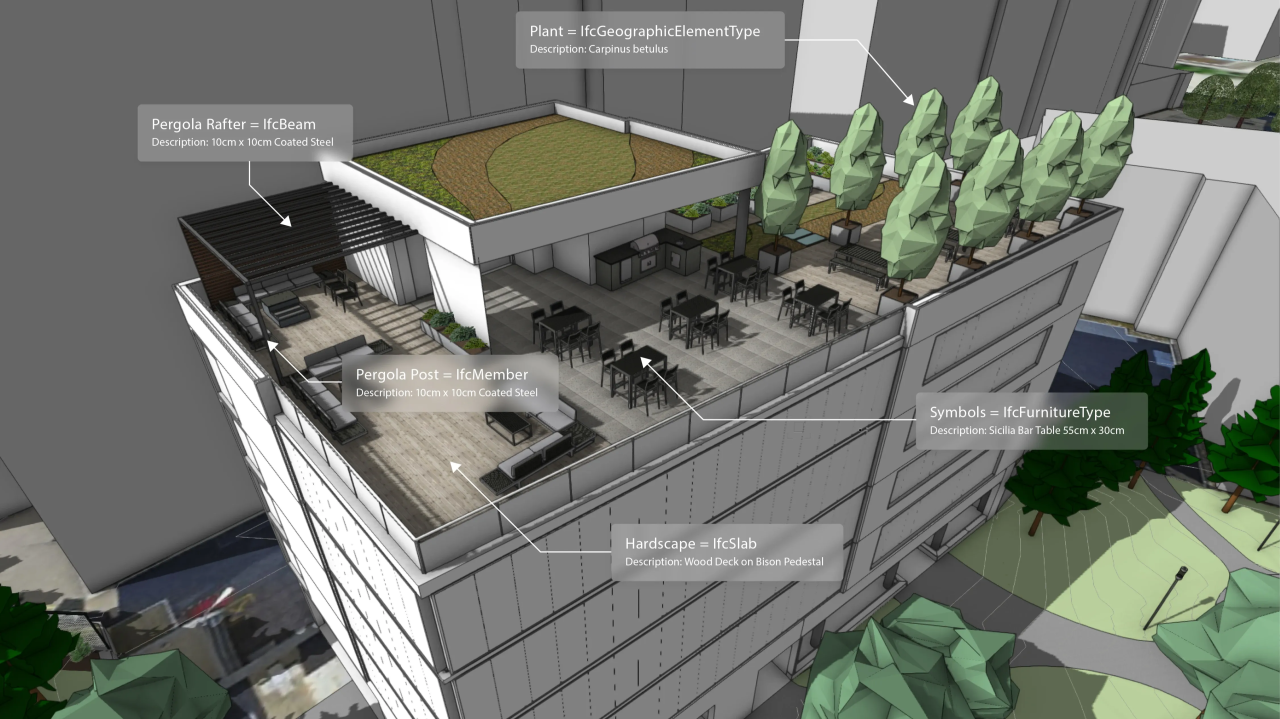
In modern architecture, engineering and construction, Building Information Modeling (BIM) is a crucial tool for design and project management. One of the key BIM standards is IFC (Industry Foundation Classes), an open format that lets designers and engineers store and share project data in a standardized digital way.
In this article we look at IFC files, how they can be used in web-based BIM projects, and the tools available for combining them with 3D technologies like Three.js. We also introduce THAT Open Company, which focuses on bringing BIM data into 3D visualization and interaction on the web.
1. What are IFC files?
Definition: IFC is an open standard for exchanging data between different design and engineering applications. It holds detailed information about the components of a building — walls, roofs, HVAC systems and more.
Key features: IFC files contain not only the geometry of the model but also text data, properties and technical specifications for each component, such as materials, dimensions and even environmental conditions.
2. Using IFC files in web-based BIM projects
Integrating BIM data on the web. One of the main challenges of web-based BIM is transferring and displaying complex data. With IFC files, this data can be converted into formats that web platforms can use easily.
Loading and displaying 3D models in the browser. With libraries like Three.js, models derived from IFC files can be shown interactively in the browser, so engineers and designers can visualize, manipulate and review them in a digital space.
Interacting with BIM models on the web. Augmented and virtual reality are another important way to present BIM models interactively, and technologies like Three.js and WebXR are very helpful here.
3. THAT Open Company and BIM platform integration
THAT Open Company builds open-source tools for bringing BIM data into 3D web visualization, using modern web technologies such as WebGL, Three.js and IFC.js. Its tools integrate with BIM platforms so designers and engineers can extract and visualize 3D models from BIM data online.
Key features of THAT Open tools:
- Loading and displaying IFC files — visualize IFC models in 3D directly in the browser.
- Interactivity — users can interact with the model and get more information about each component.
- BIM standards compliance — support for several versions of the IFC format and synchronization with different BIM applications.
4. Challenges and solutions for IFC on the web
Large file sizes. BIM models can contain huge amounts of data, which makes them slow to load on the web. Compression, progressive loading and model optimization help mitigate this.
Optimization techniques. Three.js can load models progressively and use Level of Detail (LOD) to improve performance when displaying complex models.
Conclusion
IFC files play a crucial role in BIM projects, providing an open, standardized format for sharing building data. They make it possible to connect BIM models with 3D web technologies for interactive and immersive experiences. With tools like THAT Open, which make IFC models viewable on the web, designing, reviewing and managing building projects becomes more accessible and efficient.
You can see one of my related projects, a simple online IFC viewer.